Shopping Cart (0)
Close

If you’re trying to build a Ford Ranger for towing, touring, or proper daily drivability, don’t start with shiny parts. Start with the right tune, then fix the heat, then upgrade airflow and hardware in the right order. This guide lays out proven upgrade paths for Ford Ranger tuning and the best Ford Ranger performance upgrades that actually deliver.
Jump to: Ranger models & engines • Stage 1/2/3 build paths • ECU/TCU tuning • Supporting mods • Towing build checklist • Shop Ranger upgrades • FAQ
Most generic “Ranger upgrades” lists are messy because they ignore model differences. Here’s the practical breakdown for Ford Ranger ECU tuning and compatible performance parts.
Browse Ranger-compatible parts fast: PX2 • PX3 • Next-Gen (RA) • Shop all products
The cleanest way to build a Ranger is to match upgrades to a goal. Below are proven upgrade paths that work for towing, touring, off-road drivability, and daily performance.
Start here: ECU Dyno Tuning • Talk to us about your Ranger build
A real Ford Ranger tune isn’t a generic “more boost” file. Done properly, tuning is about how torque is delivered, how boost is controlled, how smoke is managed, and how the vehicle behaves under load.
If you’re building for towing, read this: Towing with a Tuned Diesel — What Changes, What to Watch
Want a remote option (when suitable)? Alientech Powergate ECU Tuning Device (tuning file included)
One of the most effective Ford Ranger performance upgrades is an intercooler upgrade. Why? Because heat kills consistency. When intake temps climb, performance drops and stress goes up. A quality intercooler helps your Ranger hold power longer, especially on hills, towing, or in QLD heat.

Shop: Process West Front Mount Intercooler Kit (Ranger/BT-50)
Modern turbo diesels recirculate crankcase vapours. Over time, oil mist can contaminate intake piping and sensors. A quality catch can or air-oil separator helps reduce that oil vapour, keeping things cleaner and more consistent long-term.
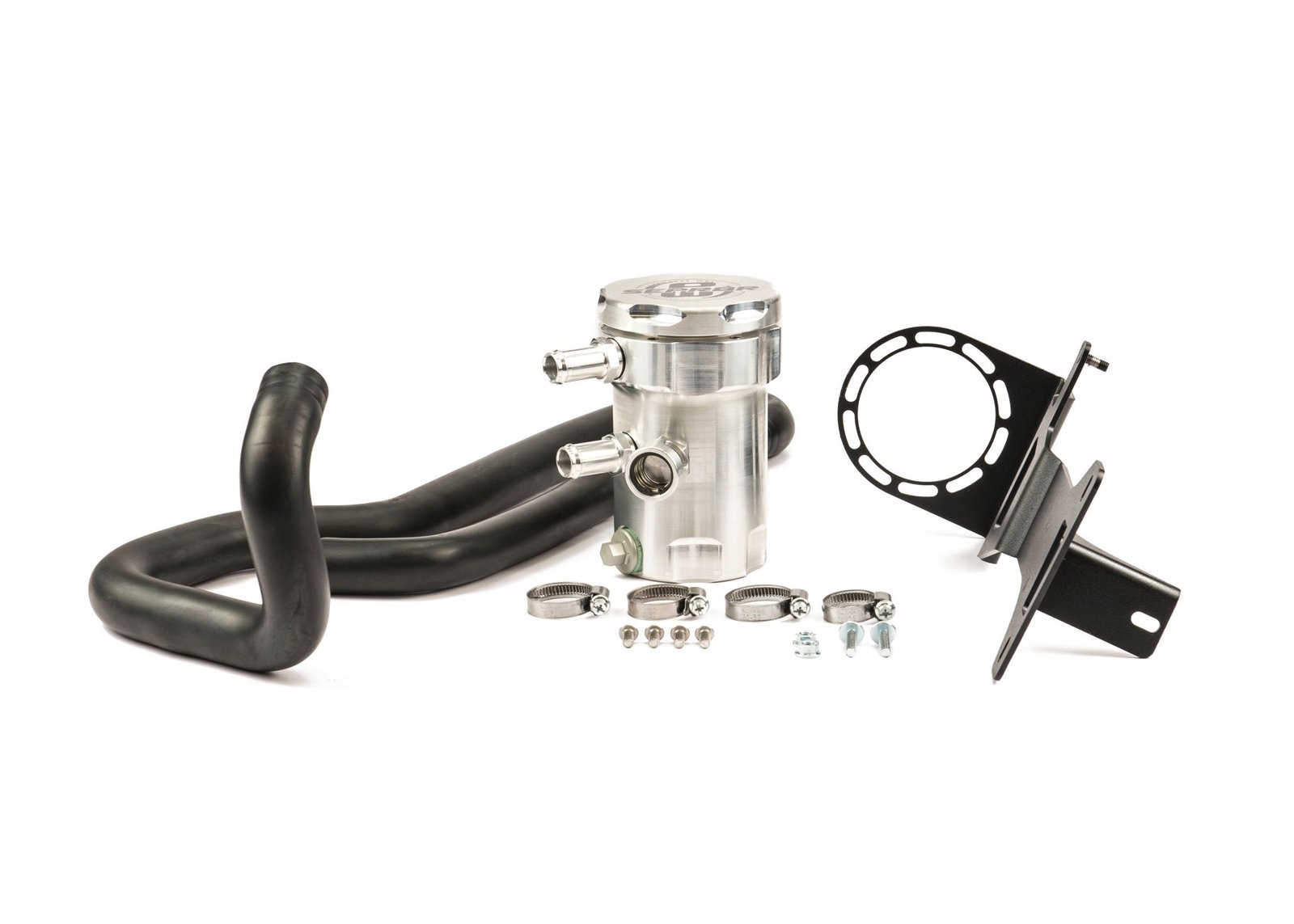
Shop: SEPR8R Air-Oil Separator (Ranger PX / BT-50)
A turbo upgrade can be a weapon, but only if the rest of the build supports it. If you haven’t sorted cooling, intake temps, boost control, and tuning strategy, a turbo upgrade is usually money spent in the wrong order. Do it when you’ve outgrown Stage 1–2 and you want a setup that stays controlled, repeatable, and safe.
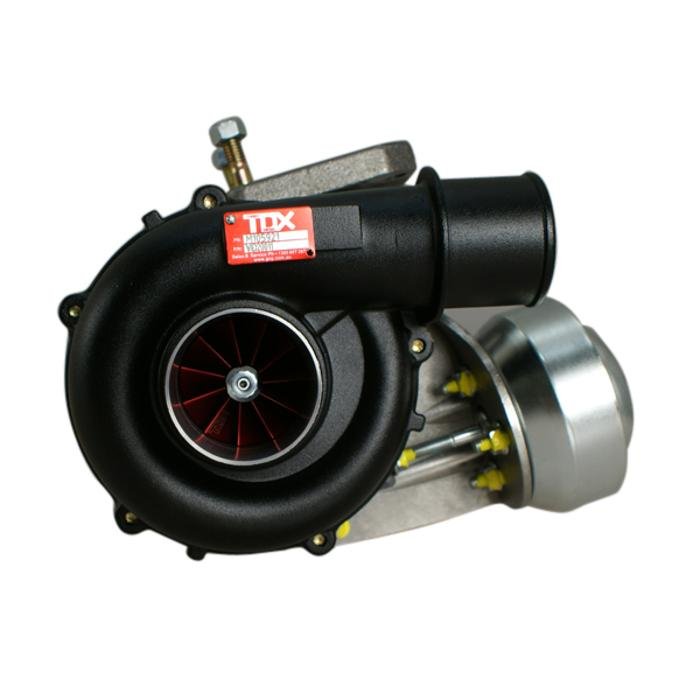
Shop: GCG TDX RHV4 VJ38 Turbo Upgrade
If your Ranger tows, this is your priority order. This is where Ranger builds succeed or fall apart.
Want help planning the build? Start here: Contact SC Diesel Tuning
Use these collections to find compatible parts fast:
If you want better torque delivery, safer overtakes, and improved towing drivability, yes. A proper Ford Ranger ECU tune is usually the best first step because it changes how the whole package behaves under load.
If you tow, tour, or drive in heat, an intercooler upgrade is one of the smartest supporting mods because it helps reduce intake temps and maintain consistent performance under load.
Poor tuning and neglected maintenance hurts reliability. A sensible calibration with realistic targets and the right supporting mods is designed for real-world load management.
Always disclose modifications to your insurer. If you’re unsure, ask before you build. Our terms: SC Diesel Tuning Terms & Conditions
Want your build mapped out properly? Talk to us here.
If you’re over the engine cutting out at lights, this guide shows the module configuration changes used to disable the
Auto Start/Stop function on the 2023+ VW Amarok and 2023+ Ford Ranger (Next-Gen).
Important (read this first)
Plug in the correct adapter for your vehicle, turn ignition ON (engine OFF), connect in FORScan, and let it build the vehicle profile.
Before changing anything, confirm the required modules appear in the list.
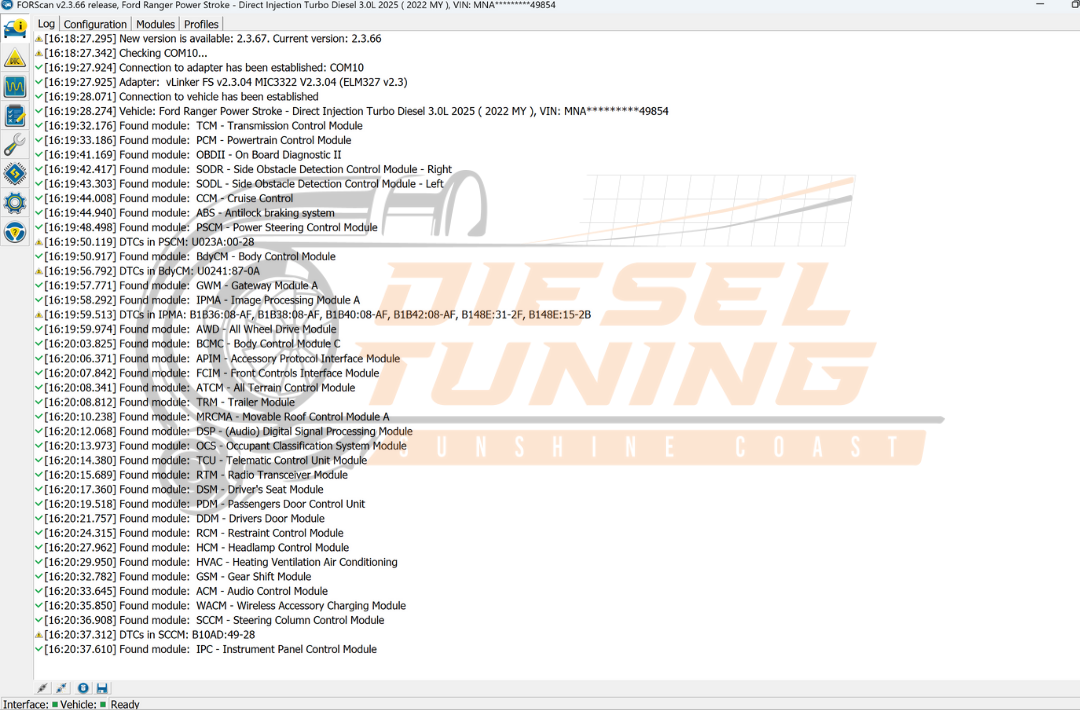
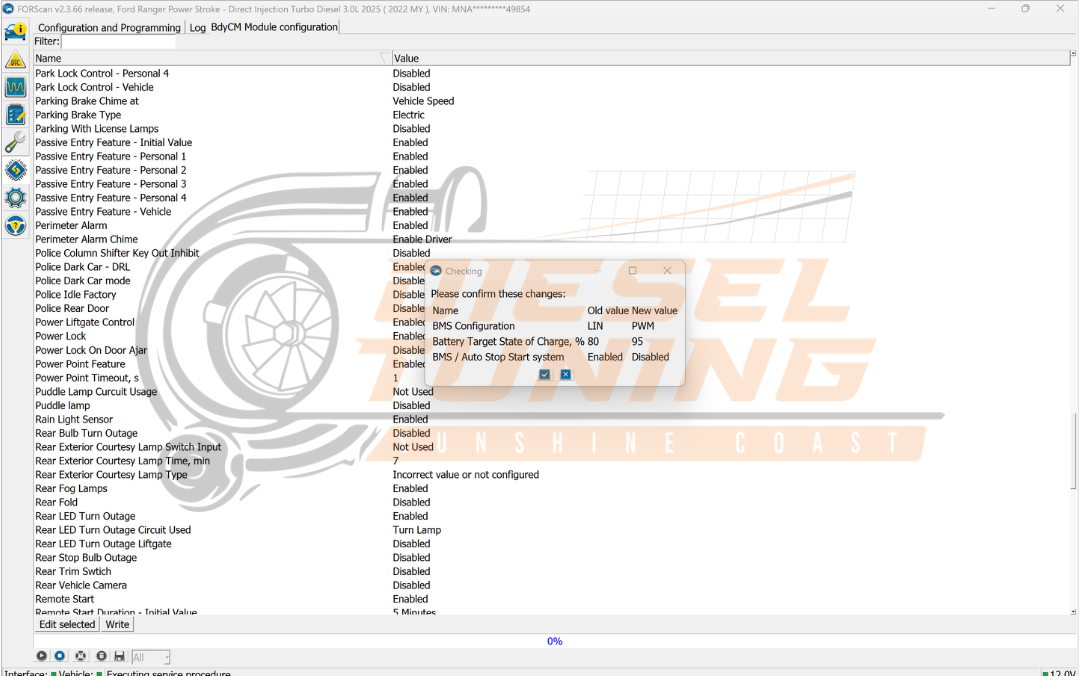
These are the key changes that disable Start/Stop logic and adjust battery strategy.

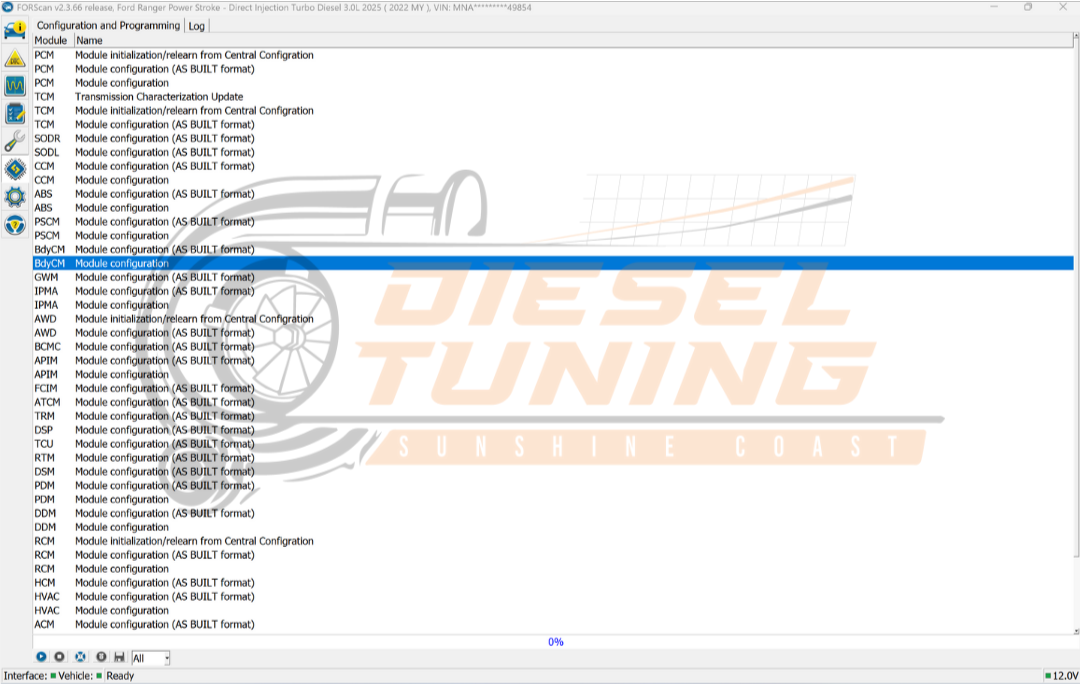

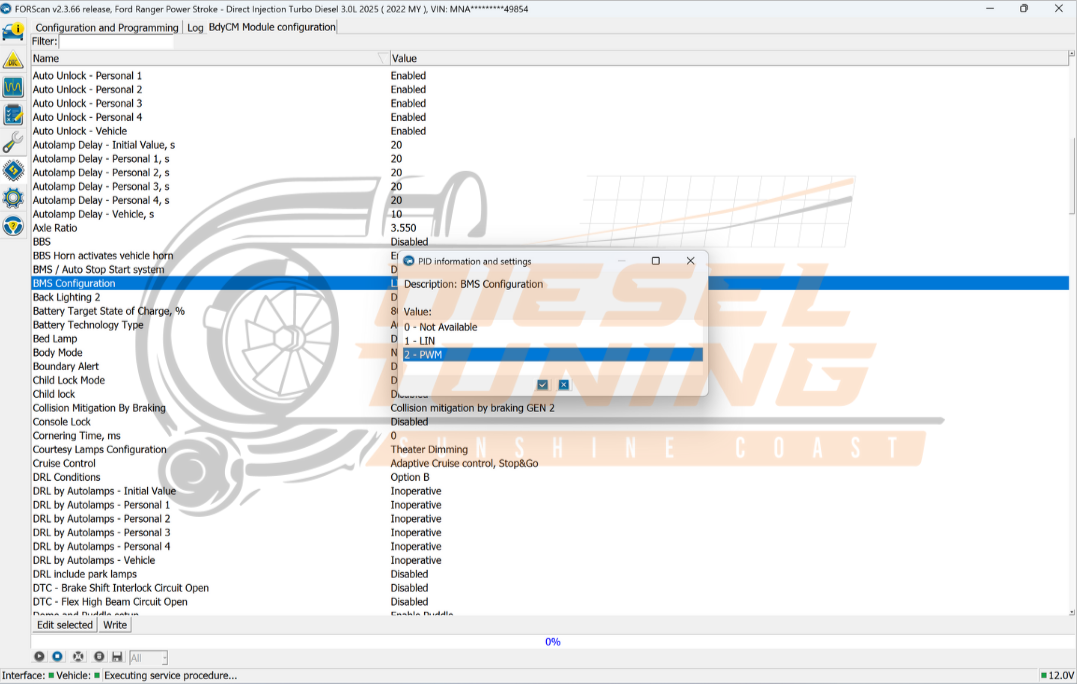
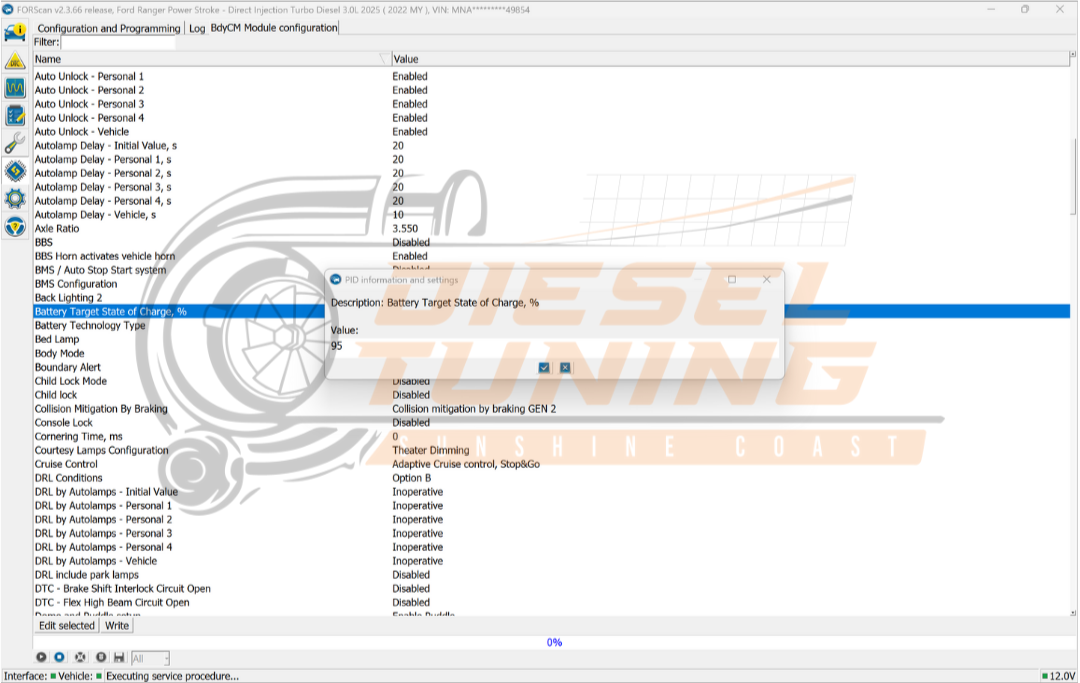
This step disables Start/Stop strategy inside the HVAC module so the system doesn’t try to influence Start/Stop behaviour.

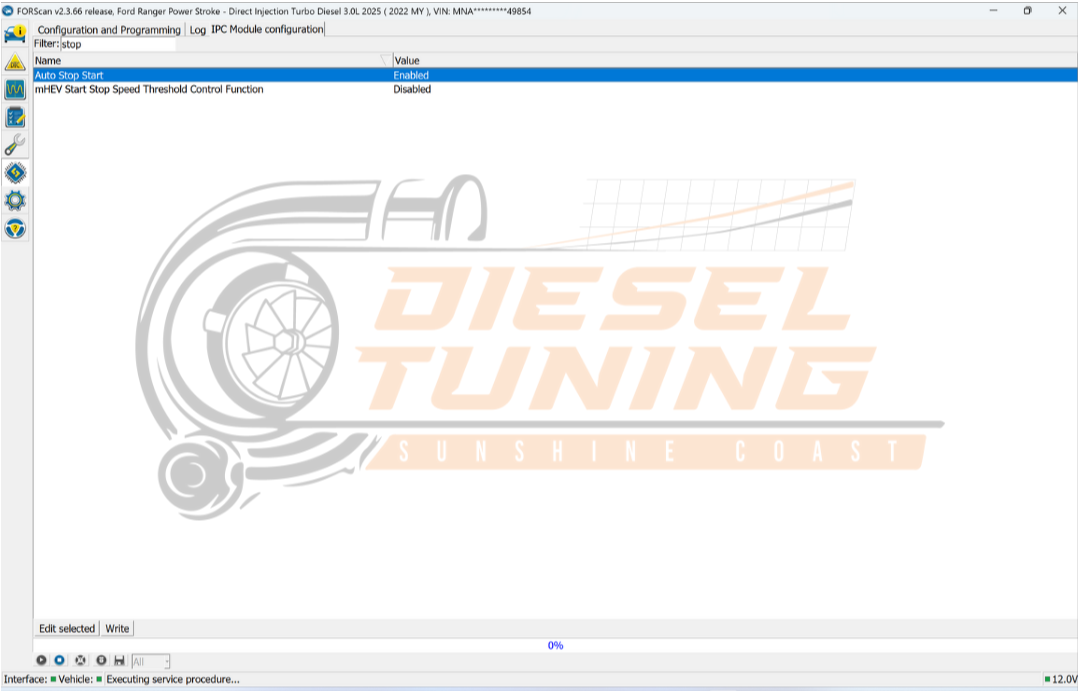
Some vehicles will still show Start/Stop options or prompts in the cluster or infotainment even after it’s disabled.
These steps clean that up.

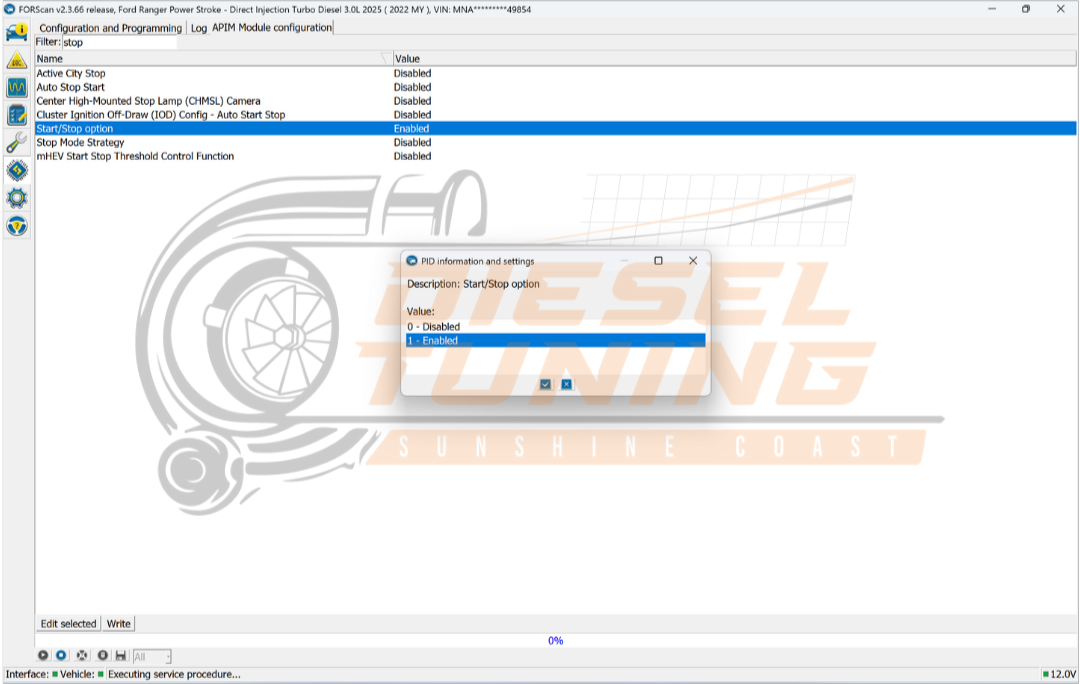
If you’d rather not touch module coding, book in with SC Diesel Tuning. We’ll disable Start/Stop properly with voltage support,
confirm module writes, and check for faults.
Sunshine Coast Diesel Tuning
6/3 Commerce Ave, Warana QLD
Call: 0423 108 474
A well-built diesel towing tune can make a heavy caravan or trailer feel dramatically easier to manage. You get more usable torque, cleaner throttle control, and better drivability on hills. But towing is also the exact place where you want things done properly: safe torque delivery, sensible temperatures, and a setup that protects your engine and transmission.
If your goal is a reliable, strong towing tune for your diesel 4×4, this guide breaks down what changes after tuning, what to monitor (coolant, transmission temp, EGT), and which supporting upgrades actually matter — including transmission cooler kits and catch cans.
If you want us to recommend the right setup, head here: send your rego + towing weight + mods.
A proper ECU tune for towing isn’t about chasing a hero dyno number. It’s about improving control and keeping everything stable under load. Towing loads the engine for long periods — especially into headwinds, on long climbs, or at highway speeds — so the tune needs to be built for sustained work.
Most towing happens in the mid-range. A towing-focused calibration improves usable torque where you actually drive: pulling away with a trailer, holding speed on hills, and overtaking without constant downshifts.
Tuning can improve throttle mapping so the vehicle feels more predictable when you’re feathering the pedal through corners, roundabouts, or uneven terrain while towing. That “on/off” feeling is what makes towing fatiguing.
When the tune is designed for towing, it can help the vehicle hold the right gear more easily because the engine produces cleaner, more consistent torque. That said, if the transmission strategy is the real problem, TCU tuning for towing may be the missing piece (more on that below).
The best towing tunes feel calm on climbs. Instead of constant hunting and heat build-up, the vehicle holds gears more confidently, pulls smoothly, and stays predictable.
Towing performance is great — until temperatures and shift quality get ignored. If you tow regularly, you should treat monitoring as non-negotiable.
If you’re unsure whether your vehicle is running safely under load, start with our ECU Dyno Tuning process and we’ll map the setup to how you actually tow.
If you’re serious about towing reliability, tuning is only one part of the package. The right supporting mods reduce heat, protect components, and keep performance consistent.
A transmission cooler kit helps keep transmission fluid temperatures under control when towing — especially on long climbs, sand, stop-start traffic, or hot summer highway runs. Cooler fluid means:
Browse towing-focused options here: Heavy Duty Transmission Cooler kits and Towing upgrades.
Popular examples: Ford Ranger PX 3.2 Transcooler Kit | Ranger/Everest/Amarok 3.0 V6 Transcooler Kit
A diesel catch can helps reduce oil vapour and blow-by contamination entering the intake system. Why that matters for towing: sustained load = sustained heat and airflow demand. A cleaner intake tract supports more consistent airflow and reduces the long-term carbon and sludge build-up that can hurt efficiency and drivability.
Browse options here: Catch Can Kits. Example for late-model 3.0 platforms: Ranger/Everest/Amarok 3.0 Catch Can.
Towing can expose heat soak fast. When intake temps rise, power can fall and the vehicle can feel lazy. Improving charge-air cooling and reducing restrictions can help maintain consistent performance on long pulls.
If you want to browse parts aimed at towing reliability, start here: towing upgrades.
If your transmission is hunting, flaring, downshifting constantly, or just feels confused under load, TCU tuning (where supported) can make towing feel far more controlled. A good TCU calibration can improve shift logic, torque management, and overall gearbox behaviour so it holds gears more sensibly and drives cooler.
The simple rule: if the engine feels capable but the gearbox feels messy, it’s time to talk TCU strategy. Send your details and we’ll tell you what’s possible for your platform: rego + towing weight + mods.
If you want a tailored recommendation (not generic advice), start here: ECU Dyno Tuning or contact us.
Sometimes. Many towing setups see improved efficiency because the engine works less to maintain speed. But towing economy depends heavily on weight, speed, wind, tyre choice, and gearing.
If you tow heavy, tow often, or tow in heat/hills/sand, a transmission cooler is one of the best reliability upgrades you can do. Heat is the main enemy of automatic transmissions.
Mid-range torque and control. Towing is about holding steady power under load, not chasing a peak number at the top end.
Off-road, traction and heat management matter more than peak power. The fastest way to break things in a diesel 4×4 is too much throttle, too much boost, and too much wheelspin. A few small changes in technique can save clutches, automatic transmissions, tyres, and driveline parts — especially when touring loaded up.
If you want your vehicle set up for diesel 4×4 touring, off-road reliability, and real-world drivability (not hype), start here: ECU Dyno Tuning or book in / message your rego + mods.
Tyre pressures are the biggest traction “mod” you have. Lower pressures increase the tyre footprint, reduce wheelspin, and smooth out corrugations. But there’s a trade-off: lower pressures mean more sidewall flex, more heat in the tyre, and more risk if you drive too fast.
Practical tip: start with a small reduction, test, then adjust. Avoid high-speed cornering and sudden braking on aired-down tyres.
Related products (touring setup): off-road wheels and off-road exhaust.
Off-road driving isn’t about big power. It’s about control. The best off-road drivers use smooth inputs so the tyre stays hooked up. In a turbo diesel, that means avoiding sudden throttle stabs that create boost spikes right when traction is limited.
If your diesel feels too “snappy” off-road (touchy pedal, surging boost, inconsistent response), a properly calibrated setup makes a big difference. That’s the point of our custom ECU dyno tuning: power you can actually use.
Low range isn’t just for extreme terrain — it’s for control. Using low range earlier reduces stress on the drivetrain because you don’t need big throttle inputs to move the vehicle. It also improves engine braking on descents and helps the gearbox stay stable.
Off-road driving can create sustained load at low road speed — which is the perfect recipe for heat build-up. Long soft-sand pulls, towing in sand, and slow climbs are where temps climb fast.
If you’re touring a lot, airflow and cooling upgrades matter: diesel intercooler kits | intercooler hoses | example: Ranger/Everest 3.2 intercooler upgrade.
The right mods don’t just add power — they reduce stress and keep the setup consistent. Here are upgrades that make sense for off-road touring diesels:
If you do slow sand, towing, or hilly tracks, a transmission cooler is one of the most practical reliability upgrades. It helps keep transmission fluid temps under control when the torque converter is working hard.
Browse: heavy duty transmission coolers | transmission cooler upgrades | touring transmission
A catch can helps reduce oil vapour contamination entering the intake. For touring vehicles that live under load and heat, keeping the intake path cleaner helps long-term consistency and reduces sludge build-up in intercooler piping.
Browse: catch can kits
For dusty touring routes, snorkels can help with cleaner air intake placement and water crossing margin (done properly).
Browse: Safari snorkels
If you’re building a reliable touring rig, start here: touring performance.
Want us to check your setup before a trip? Book in and we’ll go over it properly.
It depends on vehicle weight, tyre construction, wheel setup, terrain, and speed. Start with a small reduction, test traction and ride, then adjust. Reinflate before highway speeds.
Soft sand creates high load at low road speed
Most diesel problems don’t “just happen” — they build up quietly. A slightly restricted fuel filter, a small boost leak, a weak battery, old coolant, or the wrong oil spec
can turn into hard starting, limp mode, overheating, turbo issues, injector problems, and transmissions that hunt or shudder under load.
This guide is a real-world checklist of diesel maintenance that prevents expensive failures. If you want a reliable ute or 4WD for towing, touring, and daily driving,
this is the stuff that matters.
Modern diesel engines are efficient, but they’re also sensitive. Small problems create heat, restriction, and low voltage — and those three things trigger most diesel breakdowns.
If you want long-term reliability, focus on:
If you’re chasing reliability and drivability, a preventative check often saves more money than another random part.
If you want us to look it over properly, book here:
Contact SC Diesel Tuning.
These are the checks that actually catch diesel issues early. This is where most “quick services” cut corners.
Oil spec matters — especially on modern diesels with emissions systems and tight tolerances. The wrong oil can accelerate wear, contribute to soot loading, and shorten component life.
We confirm the right spec, not just the right viscosity.
A restricted fuel filter can cause low rail pressure, hesitation, hard starts, and poor performance. It’s one of the cheapest parts that can prevent one of the most expensive outcomes.
If you’re unsure when it was last done, it’s due.
Airflow problems show up as smoke, sluggish response, higher EGTs, and poor economy. We check the air filter, intake path, and any signs of restriction.
Boost leaks are common and they’re sneaky. A small leak can make the turbo work harder, increase exhaust temps, and make the vehicle feel “lazy”.
We look for oil misting, loose clamps, split hoses, and poor joins.
Overheating events often start with something simple: weak cap, small leak, tired hoses, contaminated coolant, or a system that can’t hold pressure.
We check coolant condition and look for early signs of pressure issues before it becomes a tow truck situation.
Low voltage causes weird faults: random warning lights, sensor codes, poor starts, and modules dropping out. We check battery health and charging performance because voltage stability is reliability.
Even if there’s no light on the dash, stored faults can show early warning signs. A scan helps catch issues while they’re still cheap to fix.
If you need a full vehicle condition report, we also do inspections:
Vehicle Inspection Reports.
Intervals depend on how you use the vehicle. A diesel that tows, idles, and runs short trips needs more attention than a highway commuter.
Here’s a practical baseline:
Want it done properly (not rushed)? Book a logbook service or general service:
Book with SC Diesel Tuning.
Towing increases heat and load across the entire vehicle. This is where maintenance pays for itself.
If you tow regularly (or you’re planning a big trip), focus on:
If you tow and you’re considering tuning, read this:
Towing with a Tuned Diesel — What Changes, What to Watch.
If any of the above sounds familiar, don’t wait for it to become expensive. Book a diagnostic or preventative check:
Contact us.
A proper preventative check is designed to catch issues early and give you a clear plan. Depending on your vehicle and symptoms, we focus on:
If you’re also chasing better drivability and towing performance, see:
ECU Dyno Tuning.
It depends on use. If you tow, do short trips, idle a lot, or drive in hot/dusty conditions, you should service more often than a light-use highway vehicle.
Yes. It’s cheap insurance. A restricted fuel filter can create rail pressure issues, poor running, and hard starts — and it can stress expensive fuel system components.
Voltage. Modern diesels are voltage-sensitive. A weak battery or charging issue can cause modules and sensors to misbehave, even if the engine itself is fine.
Cooling system health, transmission condition, fuel/air filters, and a diagnostic scan. Those four catch most trip-ending problems early.
If you want your diesel to last, maintenance has to be more than a stamp. Book a proper service or preventative inspection and we’ll tell you what’s worth doing now vs what can wait.
Book a service / inspection here
For full terms, see:
Terms & Conditions.
A lift can improve clearance and capability, but it can also create insurance and compliance headaches if it’s done wrong. This is a practical checklist to keep your build sensible, drivable, and aligned with Queensland’s LS9/LS10 framework.
Important: This is general information only. Requirements can vary depending on your exact vehicle category, ESC fitment, parts used, and how the lift is achieved. If you’re unsure, get advice before spending money.
Need help now? Start here: Queensland Modification Plates (Mod Plate Service) or Contact us with your vehicle + intended tyre size.
If your lift needs certification, the LS10 signatory is typically certifying the vehicle against an approved LS9 design package.
If the tyre/rim change is permitted by the original manufacturer or otherwise permitted without certification, it’s typically treated as a minor modification.
Even if you don’t need a mod plate under the basic limits, you still need to build it correctly: alignment, brakes, guards, speedo and safe handling matter.
Body block rule: if the suspension lift exceeds 75mm, the allowable body block lift reduces (often to 25mm depending on the design).
Tyre diameter increase is not the same as ride height increase. A 50mm increase in tyre diameter only gives you 25mm of ride height.
If you’re chasing tyre size, plan this first. Tyre size drives everything else: clearance, gearing, speedo accuracy, braking feel, and handling.
For certified LS9 designs, the vehicle must be able to safely negotiate the lane change test (LT2). The headline “150mm max” only works if the vehicle still handles safely.
If your vehicle has ESC, it must continue to function as intended after the lift. Evidence is required and must be retained by the certifier (e.g. manufacturer approval, recalibration, or testing evidence).
Examples (popular platforms): Outback Armour Ranger PX2 | Outback Armour Ranger PX3
If you’re unsure where your build sits (basic vs complex), send us:
Contact us here: https://scdieseltuning.com.au/contact/
If you want a pre-check before certification day: Vehicle Inspection Reports
General information only. Confirm your specific setup and certification pathway before proceeding.
If you’ve ever searched “dyno numbers explained” or wondered why dyno results vary, you’re not alone. Dynos are a measurement tool — not an internet scoreboard. The real value is using the dyno to compare changes on the same vehicle, on the same dyno, in similar conditions.
At SC Diesel Tuning, we use our dyno to establish a true baseline, validate improvements, and show the full power and torque curve (what you actually feel on the road). If you’re chasing repeatable data or planning mods, start with a baseline on our ECU Dyno Tuning process and book via Contact / Appointments.
A chassis dyno typically measures power and torque at the wheels (or hubs), which means the result is influenced by more than just the engine. That’s why two dyno sheets from different shops can show different numbers even if the vehicle is unchanged.
Different dynos apply load differently and can be configured in different ways (ramp rates, smoothing, load control). Even a small change in setup can move the final number.
Most dynos apply “correction” to normalise results for air density (temperature, pressure, humidity). Depending on the standard used, corrected numbers can read higher or lower.
External reading (if you want to go deep): SAE vs STD correction factors explained, how dyno correction works (temp/pressure/humidity), HP Academy discussion on dyno correction.
On roller dynos, tyres become part of the measurement system. Tyre pressure, tyre temperature, wheel slip, and strap tension can all change the reading.
Hot conditions and back-to-back runs can cause heat soak. As intake temps rise, power often drops and the ECU may reduce output to protect the engine. That’s why “cool morning” and “hot afternoon” results can look like different vehicles.
Gear choice changes load and acceleration rate. Autos/DSGs also behave differently as temps rise (converter slip, shifting strategy, torque limits). For apples-to-apples comparisons, the gear and procedure must stay consistent.
A dyno is brutally honest. Boost leaks, dirty sensors, blocked filters, DPF restriction, or cooling issues can all show up as inconsistent results.
Peak power makes a good screenshot. The power and torque curve is what you feel: mid-range pull, response, and how well it holds power under load (especially for towing).
Related reading: Towing with a tuned diesel — what changes & what to watch.
If you want consistent data (before mods, after mods, or just to know where you’re starting), book in for a baseline and verification runs. We aim for repeatable results and a proper comparison — not a one-and-done hero pull.
Book a Dyno Session / Get a Quote
Because you’re almost certainly not comparing the same dyno, settings, temps, tyres, or procedure. Use the dyno to compare changes on the same setup.
Hub setups can be more repeatable because they remove tyre variables, but the key is still consistent setup and procedure.
The curve. Especially on diesels, the mid-range and torque delivery matter more than a headline peak number.